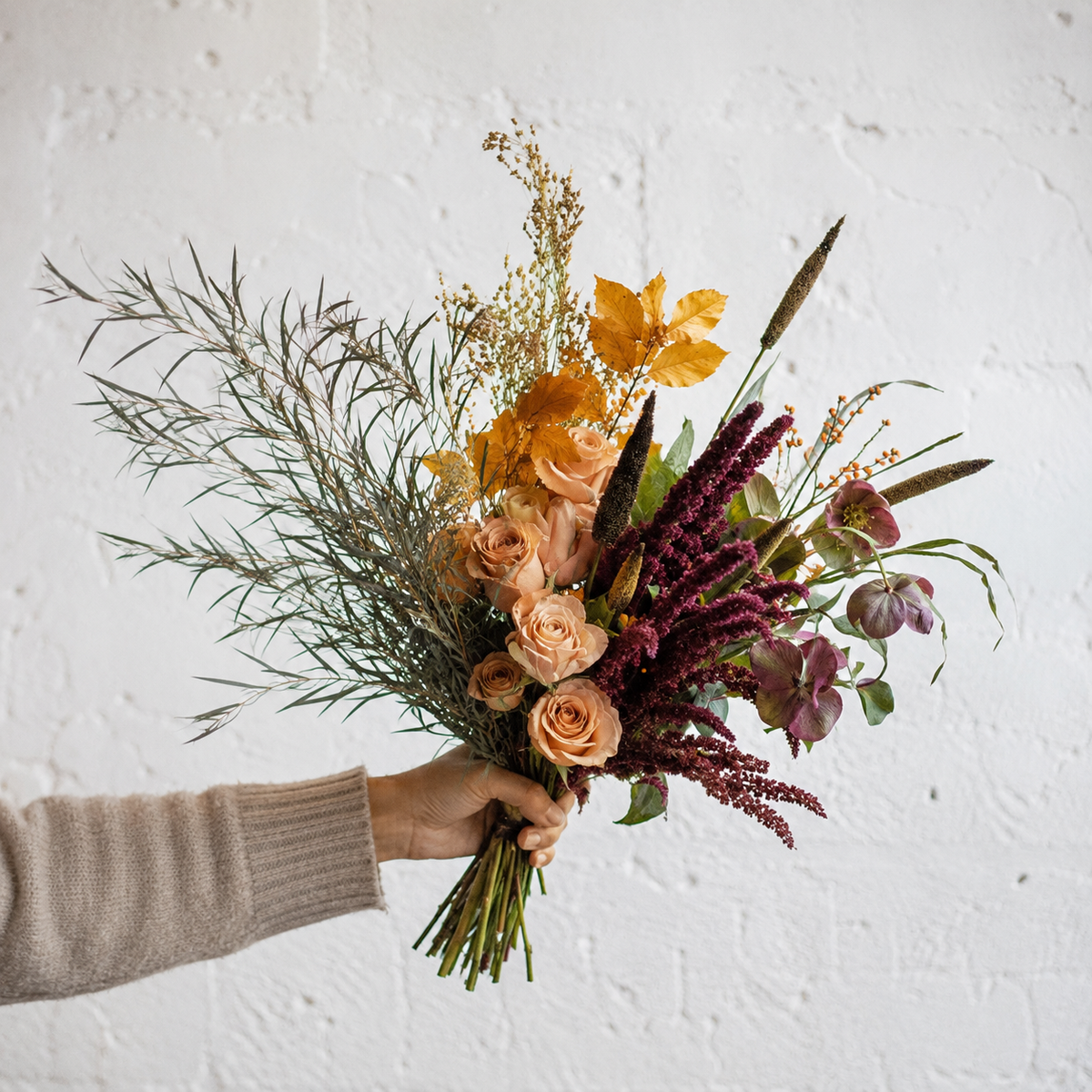
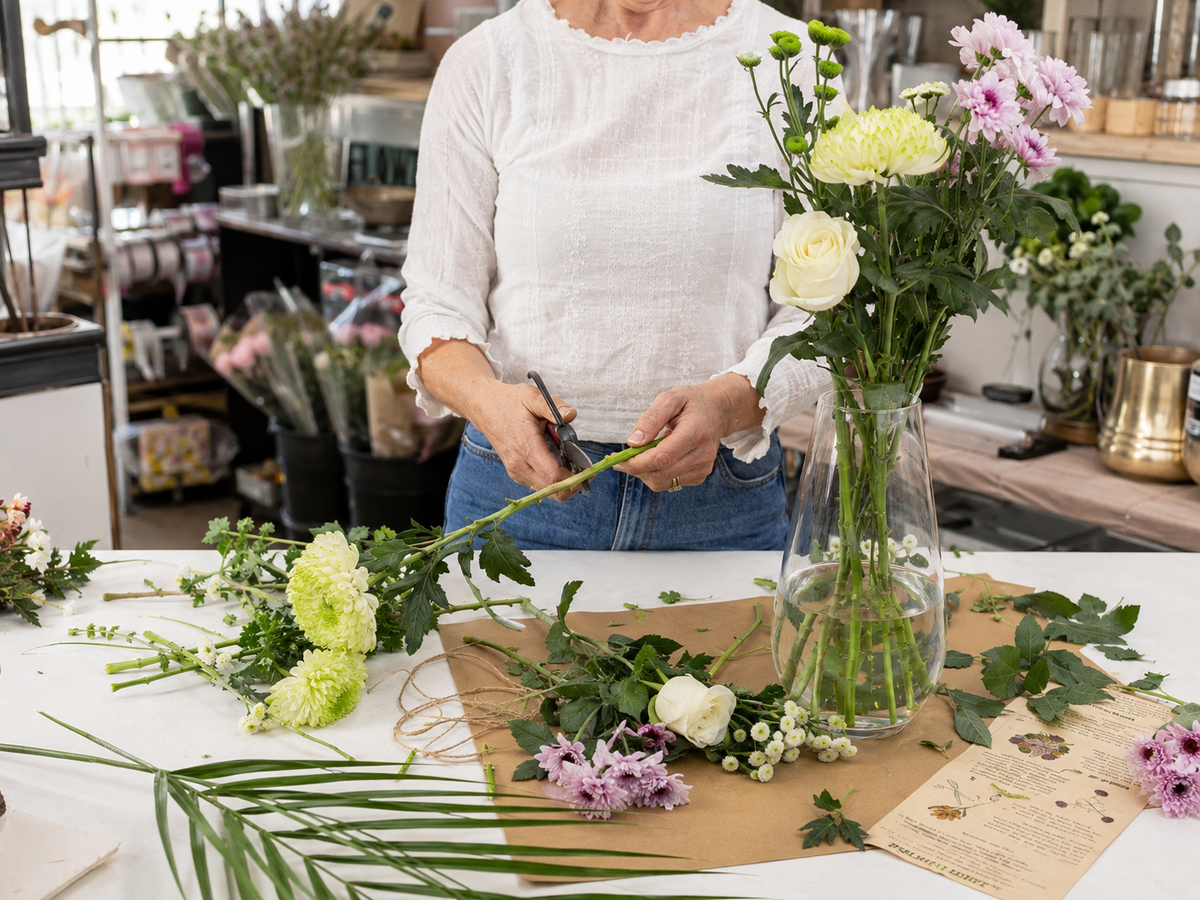
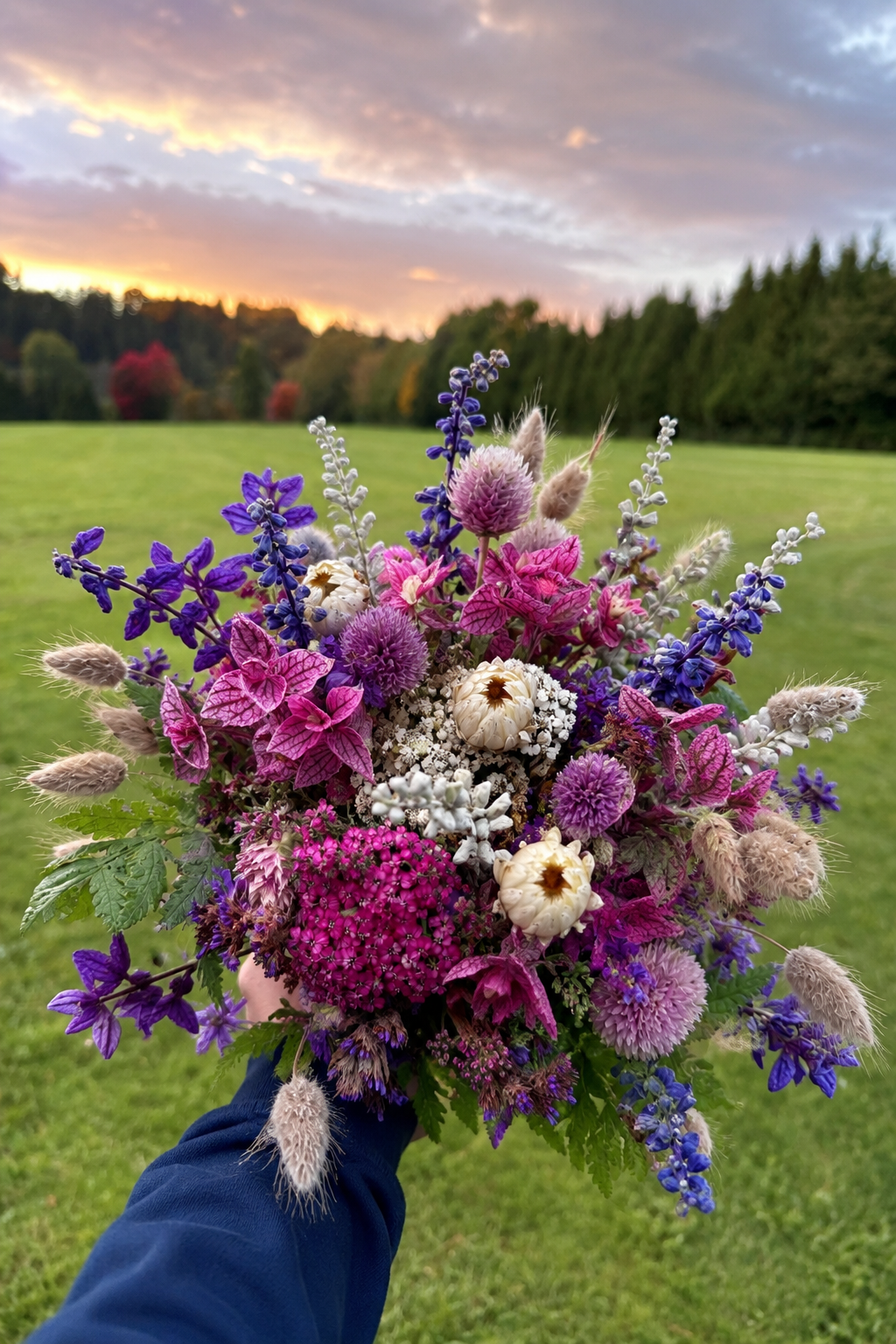
A hand-tied bouquet can look as though it simply came together by itself. In fact, there is a clear construction beneath it: the stems are added one by one in the hand, usually in a consistent direction, distributed around the form and secured at a binding point. It is this underlying order that allows the flowers above to look loose.
“Hand-tied” therefore describes how the bouquet is constructed, not a particular style. Round or asymmetrical, compact or airy, tonal or rich in colour – many looks are possible. What matters is how the stems, heights, shapes and spaces work together.
Hand-tied is a construction method, not a look
Unlike an arrangement built directly in a container, a hand-tied bouquet first takes shape in the hand. The flowers create the visible volume above; below, the stems converge at a shared working and binding point.
This construction does not dictate the result. A crisp, pared-back composition can be hand-tied just as an abundant garden-style bouquet can. The technique provides a framework; the choice of flowers, line and distribution shapes its character.
The binding point holds the idea together
The binding point is the bouquet's narrowest point. This is where the stems arranged in the hand are secured. Above it, the form can open; below it, the stems remain easy to hold as a bundle.
Its position and tension affect how closed or expansive the silhouette appears. It should hold the intended form together, not squeeze every trace of movement out of it. The effect comes not from the tie alone, but from the stem pattern it fixes in place.
One direction brings order to the stems
In the spiral technique used in many hand-tied bouquets, each new stem is added at a similar angle and in the same direction. This creates a readable pattern beneath the flowers rather than an arbitrary criss-cross bundle.
This is not a decorative trick for the underside. The consistent direction creates a reliable working point around which additional elements can be distributed. The visible ease above begins as discipline below.
Turning distributes attention
For a bouquet designed to be viewed all round, it is turned repeatedly as it is assembled. This makes it possible to check whether one type of flower sits only on one side, a colour has suddenly formed a block, or an open space is genuinely intentional.
Even distribution does not mean mirror symmetry. Individual stems may stand taller, lines may break away from the outline and one side can carry more movement. The eye should travel through the bouquet without being caught by an accidental clump.
Not every flower needs the leading role
It helps to consider flowers and foliage by the visual job they perform:
- Focal flowers draw the eye first through their size, shape or colour.
- Supporting flowers connect the standout blooms and repeat colours or shapes.
- Line flowers lead the eye outwards or upwards and define the silhouette.
- Airy accents add fine points and bring the spaces between flowers to life.
- Structure and foliage can add volume, contrast and a visual frame.
These are not rigid categories. A branching stem can connect elements, draw a line and create space at the same time. The composition becomes interesting through the relationship between these roles, not through a fixed number of stems.
Loose is a decision
A loose bouquet comes from deliberately placed gaps, varied heights and repeated forms. Some blooms are given room, while others form a small group; fine stems can reach beyond the basic silhouette. The result can feel lively without falling apart.
Loose, then, does not mean grabbing a random handful of flowers and hoping charm will do the rest. If every flower sits too close, its individual character disappears. If the flowers have no visual relationship at all, the composition falls apart. The craft lies in the tension between the two.
How to spot a coherent construction
These questions are not a universal mark of quality, but they can sharpen your eye:
- At the binding point, is a consistent stem direction visible when the bouquet uses a spiral construction?
- Does the distribution appear deliberate from the intended viewing angles rather than one-sided?
- Do important flowers have room without the supporting ingredients looking like gap fillers?
- Do different heights and lines create movement without making the overall form feel arbitrary?
- Does the binding point hold the composition together without losing its planned openness?
The clearer these relationships are, the more effortless the result can look. That is the quiet irony of good craft: you often notice the flowers first – and the construction only on a second look.
Craft that can carry many styles
A hand-tied bouquet does not have to be wild or tightly controlled, round or asymmetrical. Its quality cannot be read from a single stylistic feature. What makes it interesting is the interplay of a stable base, coherent lines and a choice of flowers given enough space.
For a visual starting point when comparing silhouettes, colours and combinations, visit the bouquets overview. Whether and how any individual bouquet is hand-tied still depends on its actual construction, not the name of a collection.