The most useful way to answer which cut flowers are in season when is to look at four broad periods. Spring centres on daffodils, ranunculus, anemones and tulips, among others. Summer brings poppies, cornflowers, zinnias and cosmos. In autumn, asters, sunflowers and more mature textures shape the picture. In winter, individual blooms such as amaryllis, Christmas roses or hyacinths are often combined with branches and evergreen foliage.
This overview is deliberately not a rigid month-by-month calendar. It describes typical main seasons and seasonal impressions. A particular flower may appear earlier or later, while what is actually available on any given day also depends on variety, cultivation, origin, weather and sourcing.
What does “season” mean for cut flowers?
When it comes to seasonal flowers, it helps to make one small distinction. The natural season broadly describes the period in which a plant flowers under suitable conditions. The main season is the period when it is especially typical and appears in greater abundance. Neither is automatically the same as the current selection in a flower shop.
Even within a single flower species, there are early and late varieties. A warm spring can bring development forward, a cool location can slow it, and protected growing can bring flowering forward or prolong it. Flowers, unfortunately, do not consult the wall calendar. A map of the seasons is therefore more useful than a list promising the same date in every place and every year.
Spring: from delicate first blooms to peonies
In floristry, spring often begins with distinct, individual forms. Daffodils, anemones and ranunculus are familiar spring flowers; tulips broaden the picture with different silhouettes. Peonies represent the later, already more abundant side of this season.
- Daffodils: an early, unmistakably spring-like accent with an upright form.
- Ranunculus and anemones: rounded and open blooms respectively, associated especially with the cooler part of spring.
- Tulips: a broad group ranging from simple to double-flowered, whose exact timing varies by variety and cultivation.
- Peonies: a late-spring signal and a natural bridge into early summer.
Transitions are particularly easy to see in spring. The first flowers do not all have to be available at once, and one kind may already be disappearing just as the next begins. If you want to choose seasonally, you will usually do better with a direction such as “light and spring-like” than with a long list of non-negotiable individual flowers.
Summer: greater abundance, movement and open forms
In summer, the range of annual cut flowers grows. Poppies, cornflowers, zinnias and cosmos are familiar flowers of this warmer, more abundant phase. Their exact sequence once again depends on where and how the plants are grown.
- Poppies: light, open blooms with an unmistakably summery feel.
- Cornflowers: delicate blooms with an unmistakable blue, likewise closely connected with summer.
- Zinnias: distinct, often bold flower forms for the warm season.
- Cosmos: airy blooms on fine stems that give the summer picture a lighter feel.
“Summer flower” does not mean that every variety remains equally present throughout the summer. Some species flower in flushes; others are grown in succession. The boundary with autumn also remains soft: zinnias or cosmos may still be present while asters and sunflowers are already shaping the later seasonal picture.
Autumn: asters, sunflowers and more mature textures
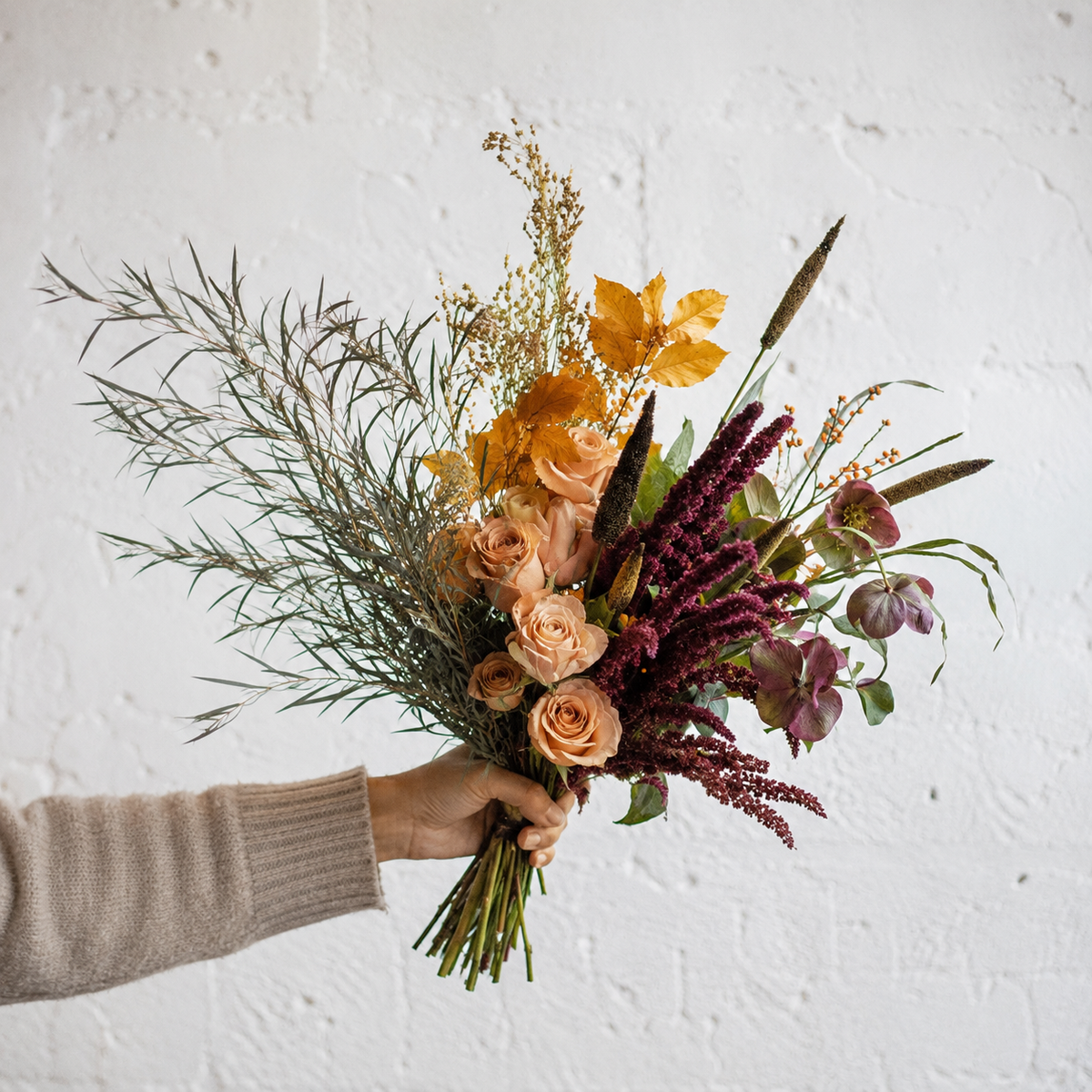
Autumn does not simply draw a line under summer. Asters and sunflowers are a recognisable part of its character, while seed heads, grasses, fruit and branches come further to the fore. That does not make the season poorer in flowers; it changes its texture.
Asters bring many smaller, star-shaped blooms. Sunflowers connect the later season with a striking, large form. Additional seed heads or grasses show that a seasonal bouquet is not read through individual flower types alone. The colours and compositions this can create are a subject in their own right; here, the first concern is seasonal timing.
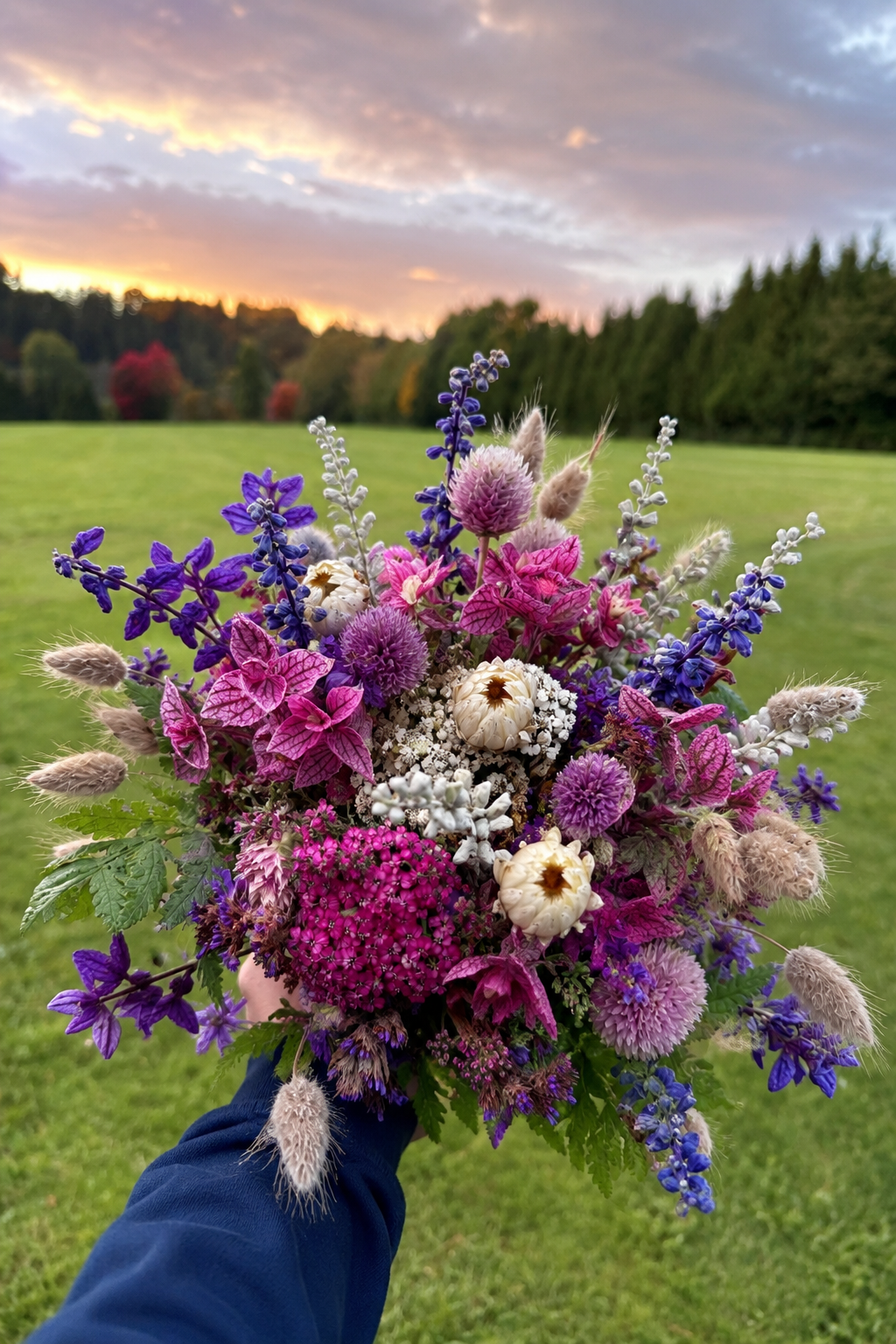
This period also has soft edges. Late-summer flowers can continue into autumn, while the first cold nights may quickly end the outdoor season for some types. Autumn is therefore a useful grouping, but not a guaranteed availability window for every flower named here.
Winter: fewer flowers, strong individual blooms and branches
In winter, the range of flowers naturally blooming outdoors becomes smaller. The winter spectrum includes hyacinths and evergreen branches, among other things. In winter floristry, amaryllis and Christmas roses also appear as striking individual blooms.
- Amaryllis: a large, architectural bloom closely associated with winter.
- Christmas roses: more restrained blooms with a distinctly wintry character.
- Hyacinths: bulb flowers with an established place in winter calendars.
- Evergreen branches: not cut flowers in the strict sense, but a typical seasonal material when floral abundance recedes.
Here in particular, the difference between natural flowering and the florist’s offering becomes clear. Bulb flowers can be forced to bloom, greenhouse cultivation changes their time windows, and what can currently be sourced influences the specific selection. A winter bouquet can therefore feel seasonal without being made exclusively from plants that are flowering outdoors nearby at that moment.
Why a seasonal calendar is not an availability list
A useful seasonal calendar gives points of reference while still leaving room for reality. Five factors can change the picture in practice:
- Variety: Early and late varieties of the same flower have different time windows.
- Region and climate: Temperature, daylight and location shift a plant’s development.
- Weather in a given year: Warmth, cold or late frosts can speed up or delay a season.
- Growing method: Protected cultivation and forcing bulbs can shift natural boundaries.
- Current sourcing: Origin and each business’s selection both help determine what is offered on a particular day.
That is why this overview says nothing about what is in stock today at Rosarium or any other florist. It helps you understand a season and describe what you would like; the specific selection begins with what is currently available.
How to ask for a bouquet with a seasonal direction
If seasonality matters to you, begin by describing the impression you want and leave some flexibility around individual flowers. “A light spring bouquet with loose forms” can be matched to the day’s selection more readily than a wish list of four species whose main seasons overlap only briefly.
You can also say whether one particular flower is non-negotiable. Then set a clear priority: one favourite flower is fixed, while the season can decide the remaining elements. This keeps the bouquet personal without asking nature to follow a timetable.